This is default featured slide 1 title

Go to Blogger edit html and find these sentences.Now replace these sentences with your own descriptions.

This is default featured slide 2 title

Go to Blogger edit html and find these sentences.Now replace these sentences with your own descriptions.

This is default featured slide 3 title

Go to Blogger edit html and find these sentences.Now replace these sentences with your own descriptions.

This is default featured slide 4 title

Go to Blogger edit html and find these sentences.Now replace these sentences with your own descriptions.

This is default featured slide 5 title

Go to Blogger edit html and find these sentences.Now replace these sentences with your own descriptions.

Showing posts with label #CCSS. Show all posts

Wednesday, 15 January 2014

NYC DOE paves the way to embrace social media for learning

While places like New Jersey, who the New York Daily News recently reported, have passed a bill requiring schools to teach acceptable use of social media, cyber safety, cyber security, ethics, and cyberbullying, the NYC Department of Education goes even further. As evidenced in their newly released student social media guidelines, they recognize the importance of social media beyond just using social media responsibly. They understand that students can embrace social media for social good, as a way to celebrate our stories, as a tool to create a positive online identity leading to college and career success, and as a way to build powerful learning networks.  


What makes these guidelines even more unique is that they were not only created for students, but also with students across New York City. Teachers and parents contributed as well. As DNAinfo recently shared, Jane Pook, the DOE’s executive director for digital communication policy and strategy explained, “It was the students who wanted this.”


This has not only been good for NYC DOE students and staff, but it's also been a relief to the Department's legal office as reported in DNAinfo.  
I want more »

Wednesday, 20 November 2013

How Social Reading Enhances the #CCSS

Guest post by Travis Alber

ReadUps is an online discussion platform where students can read online and discuss content inside the book. Actually, it doesn't have to be a book, it can also be an imported URL, an uploaded course packet, or whatever you paste in. But the purpose of the ReadUp is to "meet up" inside what students read, and to discuss it. Discussion features allow students to leave comments and responses on any paragraph, or message other readers in the book at the same time. When the ReadUp expires (usually within 2 months), the conversation and book disappear from the website.
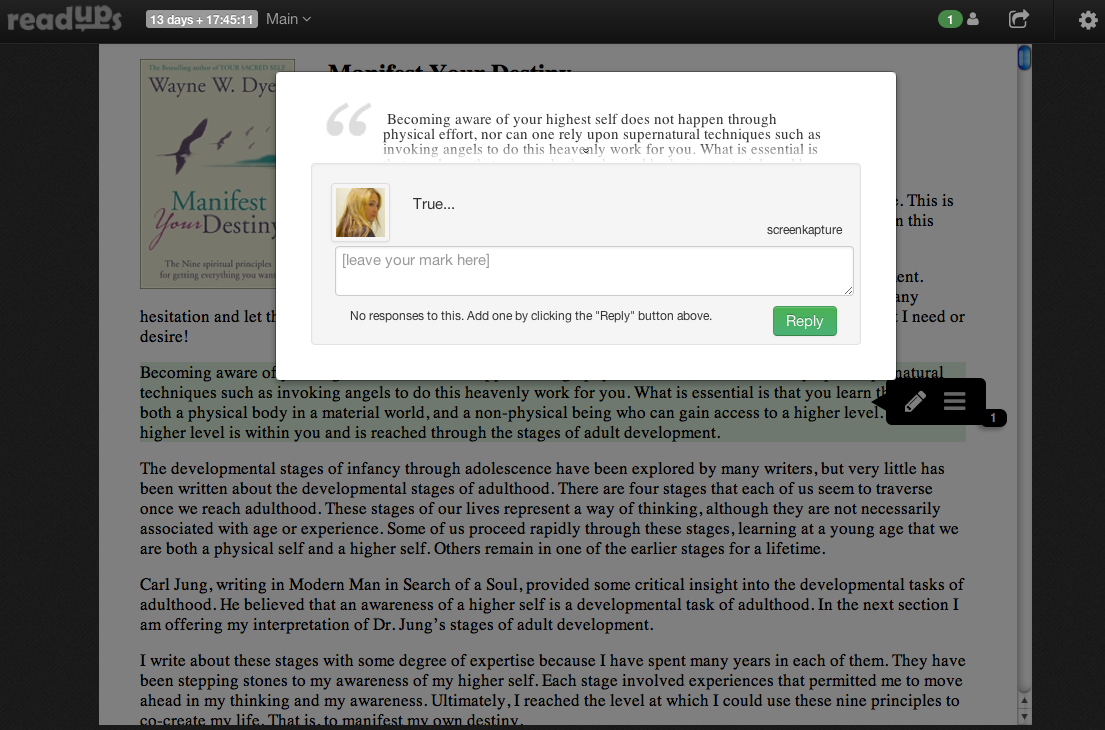
ReadUps are “Meetups” inside Books
Here are some ways ReadUps can be used to implement the Common Core

1. Contextual discussion
ReadUps is great for the close reading of texts, and a good platform for students to help other students. Students attach questions to a paragraph and get multiple answers. It's like a distributed study group that meets outside of class to help students get more from their peers.

2. Detailed analysis of the work
CCSS has a focus on critical thinking. Some teachers assign a chapter to students, and sprinkle questions throughout the text, asking students to answer a requisite number. Readups provide a good way for students to demonstrate a deep understanding of the text, and to show improved comprehension when they ask questions back.

3. Focus on Feedback
ReadUps provide an effective means to engage students in their writing assignments. Students can paste content in, ask classmates to read it, and learn how to improve their work. It's not a word processing program, it's a discussion platform, so students take away suggestions at high level, learn to consolidate their thoughts, and then edit their original document in whatever other program they’ve been writing in. Since the ReadUp only lives for a short time - in fact, students can set it to expire after a day - it allows detailed, comprehensive feedback as a simple step in the writing process.


So what do you think? Is this something you might try in your classroom? Want to try it out? Join " Sherlockian Diversions," a public ReadUp in progress [http://rdup.me/hkzit1cens714i].


Travis Alber is an entrepreneur focused on publishing innovation; her latest startup, ReadUps, offers paragraph-level discussions and reading groups inside content. Based in NYC, she has been working for 15 years on a number of web, ebook, education and mobile-related projects. Reach her at  @screenkapture [http://www.twitter.com/screenkapture].

Thursday, 17 October 2013

6 Ways Graphite™ Supports Teachers Implementing #CCSS

Here what teachers have to say here.

I recently shared that Graphite, a new, free service from Common Sense Media provides rigorous ratings and reviews of apps, games, websites, and digital curricula. This allows teachers and school leaders to connect in important ways to make informed decisions about which technology to integrate into the curriculum via reviews and “Field Notes” written by innovative educators who are using these products in the classroom.

Not only does Graphite provide an efficient and effective way to assess technology programs, but it also has a terrific component allowing educators to see how each website or app supports the Common Core State Standards (CCSS). Below are six ways to do just that.
I want more »